
 EN
EN  Romana
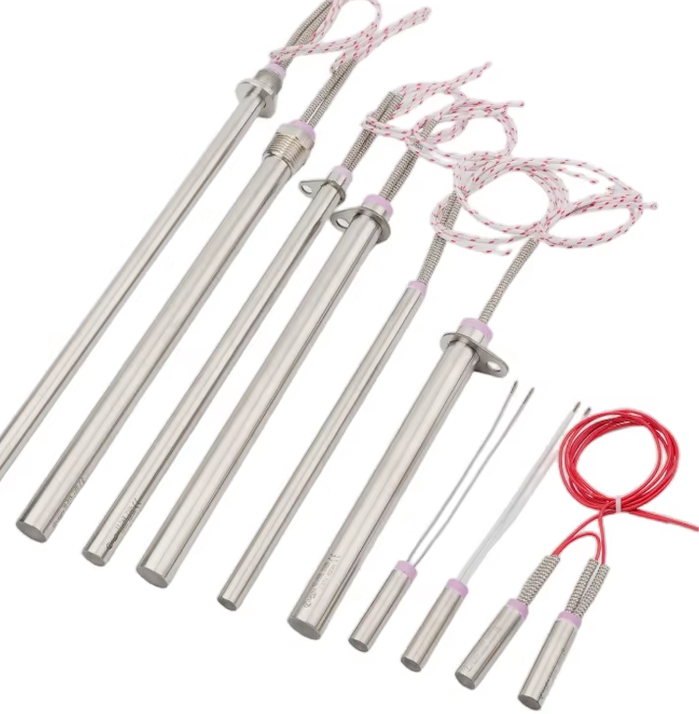
We manufacture custom cartridge heaters for molds, presses and industrial machinery
A cartridge heater is one of the most widely used industrial heating solutions when stable temperature, fast heat transfer and compact installation are required. It is used in molds, presses, injection molding machines, metal blocks, hot cutting knives, packaging equipment, special devices and many other applications where heat must be concentrated in a limited space.
At RezistenteMAG.ro, we manufacture and supply cartridge heaters in standard and custom versions, adapted according to size, power, voltage, cable type, connection type, working temperature and the real operating conditions of the machine.
We work both for the replacement of old cartridge heaters and for new projects where the customer needs a stable, correctly sized technical solution.
Available dimensions and voltages
We can manufacture cartridge heaters in several construction types, depending on the application and the customer's technical requirements.
- minimum diameter: Ø6 mm;
- maximum diameter: Ø40 mm;
- minimum length: 30 mm;
- maximum length: 4500 mm;
- supply voltage: from 12 V up to 600 V;
- power: calculated according to diameter, length, temperature and application;
- power cable: customized cable length available;
- cable exit: straight, flexible or protected, depending on the model;
- special options: thermocouple, PT100, thermostat, mechanical protection, earth wire and special power distribution.
A cartridge heater should not be selected only by diameter and length. Two heaters with the same dimensions may behave completely differently if the power, watt density, insulation or cable construction is different.
For this reason, we check the technical data for each application and recommend a construction suitable for the real working conditions.
What is a cartridge heater?
A cartridge heater is a cylindrical electric heating element designed to be inserted into a metal bore. Heat is transferred by direct contact to the body in which the heater is installed.
Inside, a high-quality cartridge heater is built with resistance wire, mineral insulation, a ceramic core and a calibrated metal sheath. Depending on the model and application, materials such as stainless steel, AISI 304, AISI 316, AISI 321 or special alloys can be used for more demanding temperatures and working conditions.
Nickel-chromium resistance alloys are commonly used for the heating wire, due to their stability at high temperature and good oxidation resistance. Compacted magnesium oxide insulation supports heat transfer and provides electrical insulation between the resistance wire and the metal sheath.
The result is a compact product with fast heating response and good temperature distribution along the active zone.
Why is watt density important?
For cartridge heaters, power is not analyzed only in watts. Watt density, expressed in W/cm², is also very important. It shows how heavily the heater surface is loaded during operation.
Depending on the application, the following versions can be produced:
- low watt density cartridge heaters for moderate heating and stable operation;
- medium watt density cartridge heaters for standard industrial applications;
- high watt density cartridge heaters for compact spaces where concentrated power is required;
- cartridge heaters with special power distribution for applications where temperature uniformity is important.
Excessive watt density, especially with incorrect installation, can reduce the service life of the heater. A watt density that is too low may lead to slow or insufficient heating. Correct selection depends on the material being heated, the required working temperature, the desired heating time and the quality of the thermal contact.
Applications for cartridge heaters
Cartridge heaters are used in many industrial sectors, including:
- plastic molds;
- injection molding machines;
- extruders;
- presses;
- heated plates and jaws;
- hot cutting knives;
- packaging equipment;
- welding and sealing devices;
- heated metal blocks;
- hot runner systems;
- industrial tools;
- laboratory equipment;
- automatic production lines;
- special machinery.
In the plastics industry, cartridge heaters are often used together with nozzle heaters, mica band heaters, ceramic heaters and thermocouples for temperature control.
Each heating element has its own role. The cartridge heater provides localized heating from inside the metal body. The band heater heats the outside of cylinders. The nozzle heater is used for compact nozzle areas. The ceramic heater is suitable for applications requiring high temperature and good efficiency.
Manufacturing according to drawing, sample or dimensions
We can manufacture cartridge heaters according to technical drawings, existing samples or dimensions provided by the customer.
For a quotation, the following information is useful:
- heater diameter;
- total length;
- active heating length, if known;
- supply voltage;
- power;
- working temperature;
- cable length;
- cable type;
- cable exit position;
- whether an integrated sensor is required;
- quantity;
- application where the heater will be installed;
- photo of the old heater or technical drawing.
If you do not know all the technical details, send us the information you have. In many cases, we can start the analysis from a photo, a diameter, a length and a few details about the machine.
For more complex projects, you can also visit our dedicated page for standard and custom electric heating elements.
Correct installation extends service life
A good cartridge heater can fail quickly if it is installed incorrectly. The most important factor is the thermal contact between the heater and the bore.
The mounting hole must be clean, correctly machined and suitable for the heater diameter. If the clearance is too large, heat is not transferred efficiently to the metal body. The heater overheats, and the internal insulation or the cable may be affected.
General installation recommendations:
- the bore must be clean, without chips, dust, burnt oil or deposits;
- the heater must be inserted along its full active length;
- the heater must not be forced with hammer blows;
- excessive clearance between the heater and the bore must be avoided;
- the cable must not touch hot surfaces;
- the heater must not be powered in open air unless it is designed for this use;
- temperature must be controlled with a suitable controller and sensor;
- the product should be stored in a dry place before installation.
For many industrial applications, an H7 bore is a good solution because it allows proper contact and stable heat transfer. However, the final tolerance must be selected according to heater diameter, length, temperature and application type.
Thermocouple, PT100, thermostat and protections
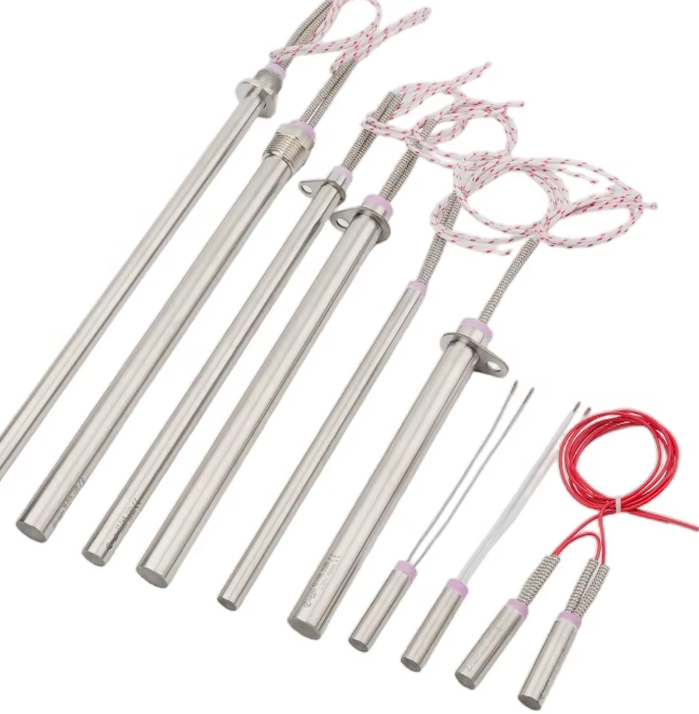
In applications where temperature must be controlled precisely, the cartridge heater can be manufactured with an integrated sensor or additional protections.
Possible options include:
- type J thermocouple;
- type K thermocouple;
- grounded or ungrounded thermocouple;
- PT100;
- thermostat;
- thermal fuse;
- earth wire;
- mechanical cable protection;
- special cable exits;
- flange or fixing system;
- different power distribution along the length.
Sensor position is important. If the sensor is placed in the wrong area, the controller may read an incorrect temperature and the machine may work unstably. For systems with several heaters, the sensor must be selected and positioned according to the area where real temperature control is required.
For temperature measurement and control, you can also see our range of thermocouples, used in molds, injection molding machines, extruders and other industrial equipment.
Connection and cable types
The connection area is just as important as the active heating section. In many machines, the cable operates close to hot zones, moving parts, oil, vibration or narrow spaces.
Depending on the application, cartridge heaters can be produced with:
- flexible cable;
- temperature-resistant cable insulation;
- metal braid protection;
- straight cable exit;
- angled cable exit;
- mechanically protected cable;
- screw connection;
- fixing flange;
- ceramic cap;
- custom cable length.
If the heater is installed in an area where the cable may be mechanically damaged, we recommend additional protection. A burned or broken cable can stop the machine even if the active heating section is still functional.
Materials used in cartridge heater construction
For industrial applications, materials must be selected according to temperature, working environment, heating and cooling cycles, vibration and heat transfer requirements.
Cartridge heater construction may include:
- calibrated stainless steel sheath;
- AISI 304, AISI 316, AISI 321 or other special materials;
- nickel-chromium resistance alloys;
- mineral insulation with magnesium oxide;
- ceramic core;
- ceramic cap or special protection;
- temperature-resistant cables;
- metal cable protections.
Choosing the correct material is especially important in applications involving high temperature, humidity, oil, repeated expansion cycles or mechanical stress.
Why do cartridge heaters fail?
In practice, many failures are not caused by the heater itself, but by the operating conditions.
The most common causes are:
- mounting hole too large;
- poor thermal contact;
- operation without sensor or temperature controller;
- cable touching hot surfaces;
- heater powered without proper heat transfer;
- power too high for the application;
- dirt or deposits inside the bore;
- moisture entering the heater before installation;
- vibration and repeated cable movement;
- incorrect voltage;
- forced installation.
For a long service life, the heater must be selected correctly and installed correctly. A part that looks simple can work very well if dimensions, tolerances and operating conditions are respected.
Cartridge heaters for high-temperature applications
Depending on construction and application, cartridge heaters can be manufactured for high temperatures and demanding industrial conditions. For these applications, watt density, sheath material, internal insulation, cable position and temperature control are all important.
High-temperature applications require special attention to:
- heat transfer;
- material expansion;
- cable selection;
- sensor positioning;
- connection protection;
- controller stability;
- ventilation or external insulation, if required.
We do not recommend selecting a heater only by power. Correct heating means a balance between power, active surface, thermal contact and temperature control.
Other heating solutions available on RezistenteMAG.ro
Depending on the machine, a cartridge heater can be used alone or together with other heating elements.
On RezistenteMAG.ro, you can also find:
- electric heating elements for industrial and technical applications;
- industrial electric heating elements;
- nozzle heaters for injection molding machines and extruders;
- mica band heaters for cylinders and nozzles;
- ceramic heaters for high-temperature applications;
- tubular heaters for air, water, oil and other media;
- flexible tubular heaters for special shapes;
- thermocouples for temperature measurement and control.
The correct choice depends on the shape of the part, temperature, working environment, available space and how the heat must be transferred.
How to request a quotation for cartridge heaters
For a fast quotation, please send us the following details:
- diameter;
- length;
- voltage;
- power;
- cable length;
- cable type or a photo of the old heater;
- working temperature;
- application;
- quantity;
- desired delivery time.
If it is an old part, a clear photo can help a lot. If you have a technical drawing, we can analyze it directly and propose a suitable production version.
We manufacture cartridge heaters for real industrial applications
At RezistenteMAG.ro, a cartridge heater is not just a catalog item. It is a technical part that must fit correctly into the machine and work reliably in production.
We manufacture cartridge heaters from Ø6 mm up to Ø40 mm, with lengths between 30 mm and 4500 mm and voltages from 12 V up to 600 V, depending on the application and the required technical configuration.
If you need a cartridge heater for a mold, press, injection molding machine, extruder, packaging equipment or special project, send us the dimensions, photo or drawing. We will analyze the request and recommend the right solution.
RezistenteMAG.ro – standard and custom electric heating elements for industry, maintenance and production.