
 EN
EN  Romana
A natural English version is below.
Electrical Heating Elements: Simple Products Only at First Glance
When someone searches for an electrical heating element, it often seems that they only need a metal component that gets hot. In practice, things are not quite that simple.
We often receive questions such as: “Do you have a 2,000 W heating element?”, “I need one for a boiler,” or “I need the same model as the one in this photo.” These are normal questions, but choosing the right product usually requires a few more details.
Two heating elements may look almost identical and still be completely different. They may have different voltages, power ratings, active lengths, materials, or they may be designed for entirely different applications.
A heating element for water should not be selected in the same way as one for oil. A heater used in a mould does not operate under the same conditions as one installed in an oven. A cartridge heater that does not fit properly into its bore may also fail much faster, even if its dimensions and power rating appear correct on paper.
This is where the difference appears between simply selling a product and choosing a solution that actually works.
What Does an Electrical Heating Element Actually Do?
In simple terms, a heating element converts electrical energy into heat. More important, however, is how that heat reaches the area where it is needed.
Sometimes the goal is to heat water inside a tank. In other cases, the system must maintain the temperature of a mould, cylinder, nozzle, or industrial installation. There are also applications where the heating element must heat air, oil, or a chemical solution.
Each situation has its own requirements.
For example, a more powerful heating element does not automatically mean better heating. It may heat a small area very quickly, but at the same time it may create local hot spots. A heater with insufficient power may operate almost continuously without ever reaching the required temperature.
For this reason, the power should be selected according to the application, not simply according to what is available in stock.
The Most Commonly Requested Types of Electrical Heating Elements
Cartridge heaters are frequently used in moulds, packaging machinery, presses, and plastic-processing equipment. They are compact, but they require very good contact with the bore in which they are installed.
If there is too much clearance between the cartridge heater and the hole, heat transfer becomes inefficient. The heater becomes hot, but the heat does not move quickly enough into the surrounding metal. Over time, this can significantly reduce the service life of the product.
Tubular heating elements are among the most versatile options. They can be straight, bent, U-shaped, or manufactured according to a drawing. They are used for heating air, liquids, ovens, tanks, and many different industrial systems.
Boiler heating elements are probably the best-known type. Even here, the thread, power, voltage, length, and material must all be checked. A heating element that physically fits into a boiler is not automatically the correct one.
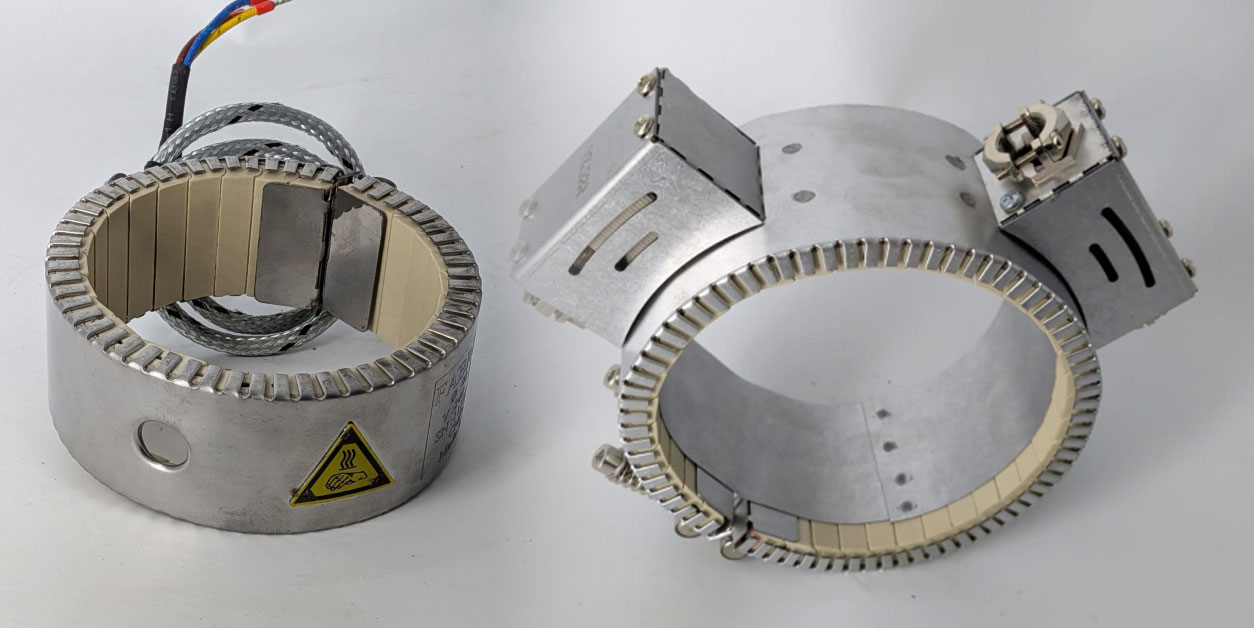
Band heaters are mainly used around cylinders, extruders, injection moulding machines, and nozzles. They can be manufactured in different diameters and widths, and the cable or terminal exit position can sometimes be just as important as the power rating.
For large tanks and industrial installations, flanged heating elements or electric heating assemblies are often used. In these applications, the calculation is more complex, and the tank volume, starting temperature, target temperature, and required heating time must all be known.
Sometimes the Customer Does Not Have All the Information. That Is Normal.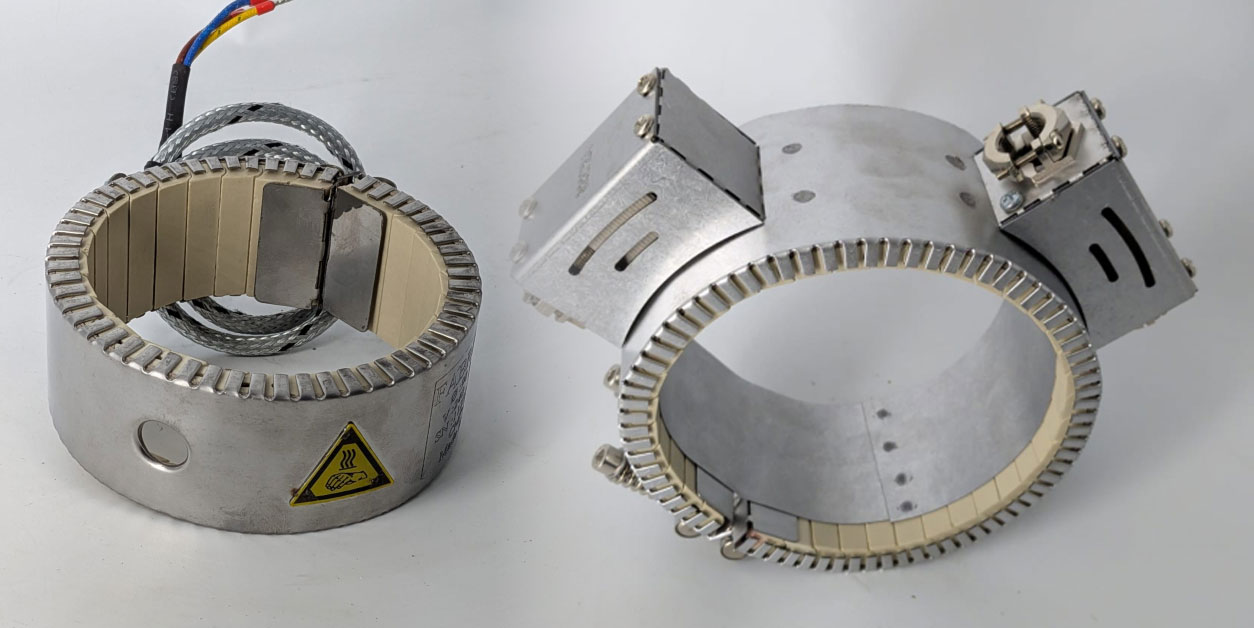
It is common for an old heating element to have no visible label. The markings may have worn off, the cable may be damaged, or the component may come from an old machine for which technical documentation is no longer available.
In such cases, customers send us photographs, measurements, and a few details about the equipment. Sometimes we only have the length, diameter, and voltage. In other situations, we need to start from the machine model or from the way the heating element was originally installed.
Not every product can be identified from a photograph alone, but a clear image can be extremely helpful. Ideally, the photograph should show the electrical connection, thread or flange, cable, complete shape, and any code or marking that can still be read.
When the old part is available, the safest approach is to measure it carefully. Even a small difference can matter, especially with cartridge heaters or parts that must fit into a fixed installation space.
Why Voltage and Power Matter
One of the most common mistakes is choosing a heating element based only on its dimensions.
A 230 V heating element and a 400 V heating element may look exactly the same from the outside. However, they are not interchangeable.
If a heating element designed for 230 V is connected to a higher voltage, it may overheat and fail very quickly. In some cases, it may also cause more serious problems in the electrical installation.
Power is equally important. We do not recommend choosing a higher wattage simply because “it will heat faster.” Sometimes that is correct, but sometimes it is not. It depends on the active surface, the medium being heated, the heater material, and the temperature-control system.
Without Temperature Control, Even the Best Heating Element Is Not Protected
The electrical heating element is only one part of the complete system.
For safe and reliable operation, temperature must be controlled. Depending on the application, this can be done using a thermostat, thermocouple, PT100 sensor, digital temperature controller, contactor, or solid-state relay.
The temperature sensor must be installed in a relevant position. If it measures the temperature too far away from the heated zone, the system may continue supplying power even when the heating element is already extremely hot.
We have seen situations where the heater was considered defective, but the real problem was an incorrectly installed sensor, poor thermal contact, or the absence of a suitable control system.
This is why, when discussing an electrical heating element, the rest of the installation must also be considered.
Why Is RezistenteMAG Important?
RezistenteMAG was created for customers who want to find electrical heating elements, temperature sensors, controllers, and industrial heating products more easily.
Some products are standard and can be ordered directly. Other applications require a technical review or custom manufacturing.
The goal is not simply to send a part that looks similar to the old one. We try to understand where it will be installed, what it needs to heat, and under which conditions it will operate.
Sometimes the answer is simple, and the product is already available from stock. In other cases, the cable length, connection position, material, power, or shape must be adapted.
For an industrial customer, choosing the wrong heating element does not only mean losing the cost of one product. It can also mean machine downtime, delayed production, and additional time lost waiting for a replacement.
For this reason, we believe technical support is just as important as the product itself.
What Information Helps Us Identify the Right Product?
For faster identification, it is useful to provide:
-
supply voltage;
-
power rating;
-
complete dimensions;
-
clear photographs;
-
operating temperature;
-
medium to be heated;
-
machine or equipment type;
-
cable type and length;
-
required quantity.
It is not necessary to have every detail from the beginning. We can start with the information available and clarify the remaining points step by step.
The Right Heating Element Can Work for Years
Service life does not depend only on the quality of the product. Installation, temperature control, heat transfer, and real operating conditions are equally important.
A correctly selected and properly installed heating element can operate for a long time. The same heater, installed in an oversized bore or used without temperature control, may fail after a short period.
It is therefore better to check a few details before placing the order than to discover after installation that the product is unsuitable.
RezistenteMAG offers both products for fast ordering and technical support for identifying or manufacturing electrical heating elements for special applications.
If you have an old heating element, a photograph, a technical drawing, or only a few measurements, you can send us the information available. We will review the application and help identify a suitable solution without unnecessary complications.